

At ONEX RF, we work with medical device engineers and catheter manufacturers every day, helping them select the right tip forming process for their specific tubing materials. One question that comes up regularly: can silicone tubing be processed on an RF catheter tipping machine? The short answer is no — and understanding why comes down to a fundamental difference in material chemistry. This article explains that distinction clearly, so engineers can make informed decisions about catheter manufacturing process selection.
How RF Catheter Tip Forming Works
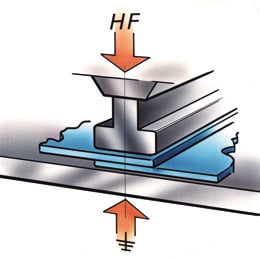
RF catheter tip forming — also called induction heating tip forming — works by using a high-frequency electromagnetic field to rapidly heat a metallic mold to a precise target temperature. The thermoplastic catheter tube is then pressed into the hot mold, where the material softens, flows into the mold cavity, and takes on the desired tip geometry. Once the mold is air-cooled, the tube is removed with a cleanly shaped, solidified tip.
ONEX RF Tipping systems can achieve die temperatures up to 500°C and form tips up to 4 inches long. This range of capability covers a broad spectrum of thermoplastic catheter materials including PEBAX, PET, polyurethane, polyethylene, polypropylene, PTFE (Teflon), PEEK, polyimide, and polyamide (nylon). The ONEX RF process uses closed-loop thermocouple feedback, RF power feedback, and precise slide position control to deliver repeatable, flash-free tips cycle after cycle.
The process relies on a critical physical property: thermoplasticity. A thermoplastic material softens reversibly when heated and re-solidifies when cooled. This melt-form-cool cycle is the entire basis of catheter tip forming technology.
Why Silicone Is Fundamentally Different
Silicone rubber is not a thermoplastic — it is a thermoset elastomer. This single distinction explains why it cannot be processed on any RF or induction-based catheter tipping machine.
When silicone tubing is manufactured, it undergoes a vulcanization (curing) process in which the polymer chains form permanent, three-dimensional crosslinked networks through covalent chemical bonds. This is an irreversible chemical reaction — not a physical change like melting. Once cured, silicone does not soften when heated. It does not flow. It does not take on a new shape when pressed into a mold. Instead, applying heat to cured silicone causes the material to degrade — it will deform, discolor, and ultimately decompose rather than reform into a new geometry.
This is the fundamental incompatibility. RF catheter tip forming requires material that will melt, flow, and re-solidify. Silicone, being a thermoset, is chemically locked after cure. No amount of heat will transition it into a flowable state.
Thermoplastics vs. Thermosets: The Core Distinction
A useful way to think about this: thermoplastic materials behave like wax — they can be melted and re-solidified repeatedly, making them recyclable and reshapeable. Thermoset materials behave like cured epoxy — once the chemical reaction has occurred and the crosslinked network is set, the material is permanently rigid (or, in the case of silicone, permanently elastic). Reheating doesn't reverse the structure; it destroys it.
This distinction also matters for process selection in broader medical device manufacturing. Thermoplastic materials are processed through heat and pressure — extrusion, injection molding, and tip forming all work within this framework. Thermoset materials like silicone are instead shaped before or during their curing reaction, using compression molding with uncured silicone compound, or liquid silicone rubber (LSR) injection molding where the material cures inside the mold under heat and pressure.
What Materials Can ONEX RF Systems Process?
ONEX RF catheter tipping systems are engineered specifically for thermoplastic catheter tube materials. The current material compatibility list includes:
PEBAX (polyether block amide) — widely used in flexible catheter shafts
PET (polyethylene terephthalate)
Polyurethane (TPU) — including both ether and ester grades
Polyethylene (PE, HDPE, LDPE)
Polypropylene (PP)
PTFE (Teflon)
PEEK (polyether ether ketone) — a high-performance engineering thermoplastic
Polyimide
Polyamide (Nylon)
PVC
ONEX RF systems can reach die temperatures up to 500°C, which is more than sufficient to form even high-glass-transition materials like PEEK and polyimide. The versatility of the platform — covering tip sizes from 2Fr to 36Fr with tapered, rounded, soft-tip, and flared geometries — makes it adaptable across a broad range of catheter product types. Silicone, however, is simply outside the scope of what heat-based tip forming technology can address.
Implications for Product Development and Material Selection
For engineers designing long-term indwelling devices such as urinary catheters, drainage tubes, or other implant applications where silicone is the preferred material for its biocompatibility and flexibility, the manufacturing approach must align with the material. Silicone tip geometries need to be defined during the molding and curing step — not post-extrusion. This means working with liquid silicone rubber (LSR) injection molding or compression molding processes rather than thermoplastic tipping equipment.
If a catheter design calls for a thermoplastic shaft paired with a soft silicone distal tip, that is a bonding challenge rather than a tipping challenge — and requires adhesive bonding, overmolding, or mechanical joining techniques.
On the other hand, if a design using PEBAX, polyurethane, or another thermoplastic can meet the product requirements, an ONEX RF tip forming system offers a direct, high-throughput solution. Systems like the ONEX RF Servo Tipping Platform run with full process control over temperature, insertion force, insertion depth, forming speed, heat zone, and cooling time — giving development teams a fast path from prototype through production validation.
Process Selection Follows Material Science
There is no workaround that makes RF tip forming compatible with silicone. The constraint is not a machine limitation — it is a material science boundary. Silicone's thermoset crosslinked structure is what gives it the properties that make it valuable (thermal stability, biocompatibility, elasticity, and chemical inertness), and those same properties make thermoplastic processing inapplicable.
At ONEX RF, we work closely with medical device development teams to match the right process to the right material from the outset. If you are in early-stage product development and working through material selection, we offer process development services — including rapid die fabrication and material testing — that can help you evaluate thermoplastic alternatives and identify the most manufacturable path forward.
Understanding why certain materials respond the way they do to heat and pressure is what allows catheter manufacturers to build reliable, consistent products. Process selection is always a direct reflection of material behavior — and getting that alignment right from the start saves time, reduces scrap, and accelerates validation.






-2.gif)


.png)
-1.png)
.png)
.png)