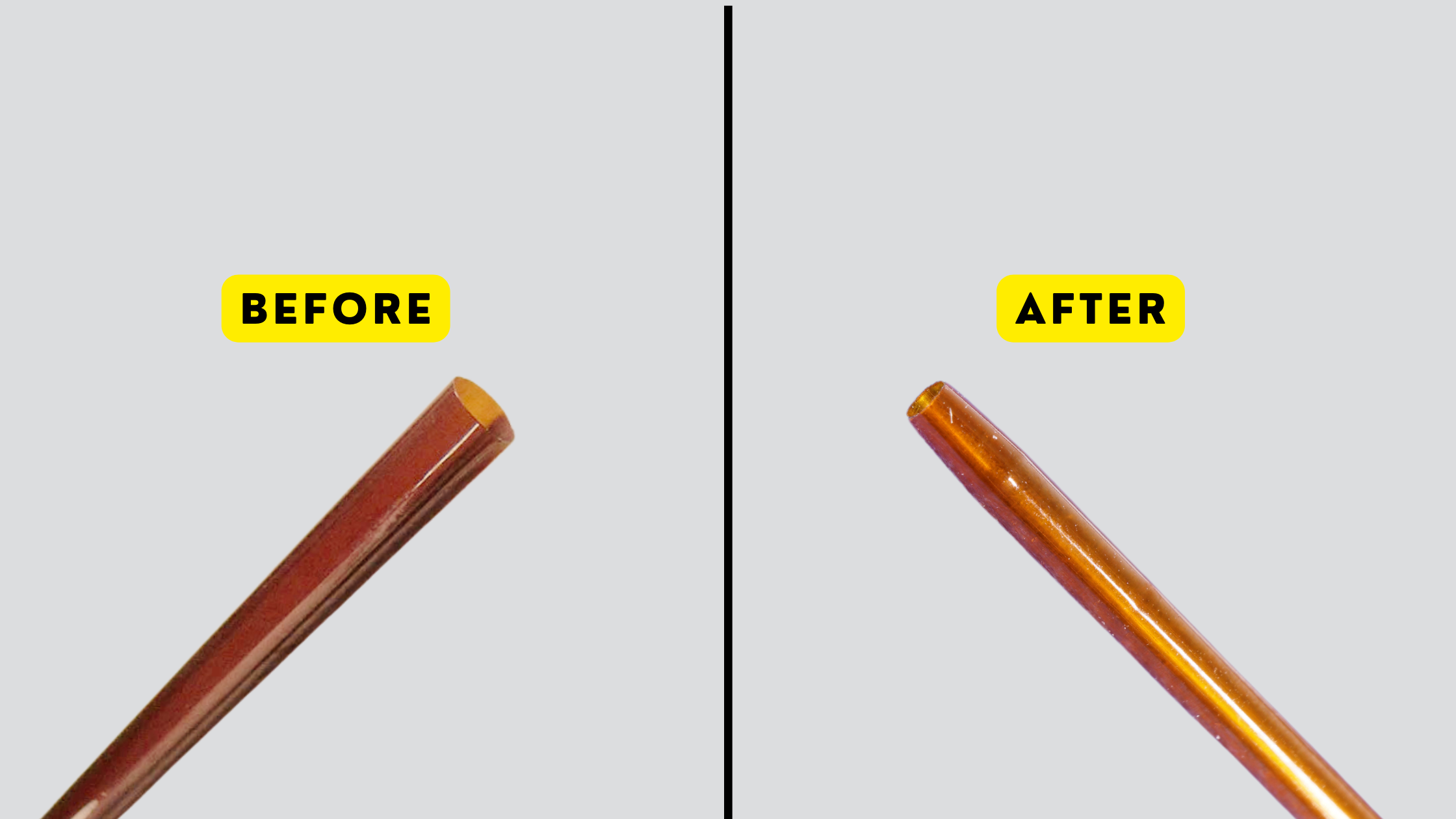


Every catheter that enters clinical use has passed through a series of precise manufacturing steps that determine its safety and performance. Among those steps, catheter trimming — the process of cutting a catheter tube to its target length and preparing the tip end — is foundational. A poorly trimmed tip leaves burrs, sharp edges, or dimensional inconsistencies that can injure vessel walls, resist passage through hemostatic valves, or fail dimensional inspection. Understanding catheter trimming methods, their limitations, and how modern automated systems have transformed what's achievable is important knowledge for any engineer working in catheter design or medical device manufacturing.
What Catheter Trimming Involves
Catheter trimming refers to the cutting of an extruded polymer tube to a defined finished length, and in some cases the shaping of that cut end to a specific edge profile. The goal is a tip geometry that is dimensionally accurate, free of sharp edges or burrs, and consistent from part to part. Because catheters are used in sensitive intravascular and intraluminal environments, the standards for tip quality are stringent — even microscopic surface irregularities can cause clinical problems or trigger a failed inspection.
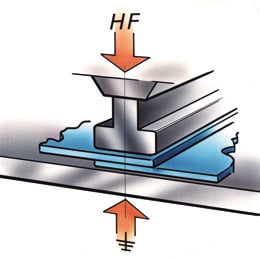
Trimming is distinct from tip forming. Trimming is a subtractive process — material is removed by cutting. Tip forming, by contrast, is a thermally driven reshaping process in which a precision die molds the catheter's polymer end into a specific geometry under controlled heat and pressure. In many catheter manufacturing workflows, trimming and tip forming are sequential: the tube is first cut to approximate length, then thermally formed to achieve the final tip shape and atraumatic profile. Understanding both processes — and where each fits — is central to designing an efficient, quality-driven catheter production line.
Manual Trimming: The Starting Point for Low-Volume Production
In early-stage product development and low-volume custom production environments, manual trimming using scissors, scalpels, or precision cutting blades remains a practical approach. A skilled technician can achieve acceptable cut quality with the right tooling and technique, particularly for single-lumen tubes in larger French sizes where the cut edge is less susceptible to micro-cracking or edge deformation.
The limitations of manual trimming become apparent quickly at any production scale. Operator variability introduces dimensional inconsistency — cut lengths, edge angles, and surface finish all depend on the individual performing the operation. Throughput is inherently limited, and the process is difficult to validate in a way that satisfies FDA quality system documentation requirements for medical device manufacturing. For prototype runs and feasibility work, manual trimming serves a purpose. For validated production, it is not a scalable solution.
Mechanical Cutting: Precision at Production Scale
Automated mechanical cutting systems — including rotary blade cutters, guillotine-style cutters, and ultrasonic cutting tools — solve the consistency problem that manual trimming cannot. These machines cut catheter tubes to precise lengths repeatedly, with minimal operator involvement, and can be integrated into larger assembly automation lines. For high-volume production, mechanical cutting is the standard approach to tube-to-length operations.
In the context of full catheter assembly automation, ONEX RF integrates tube feed cutting directly into its ATF-Galaxy Line — a modular automated catheter tipping system designed for large-scale production. Tube feed cutting is the first step in the Galaxy's workflow, followed by rotary tip forming, robotic tube transfer, linear tube indexing, hole punching or skiving, and vision inspection. This end-to-end integration eliminates manual handling between process steps, a key driver of consistency at high throughput. The ATF-Galaxy Line achieves 600 to 1,200 parts per hour at 90–95% OEE (Overall Equipment Effectiveness).
Deburring: The Essential Step After Every Cut
Any mechanical cutting process leaves residual edge artifacts. Deburring — the removal of burrs, flashing, and micro-irregularities from the cut face of the catheter — is a required step before downstream processing or final inspection. In manual workflows, deburring is often performed by skilled technicians using fine abrasive tools. In automated lines, skiving (a controlled shaving operation) can serve a similar function and is one of the module options available in ONEX RF's modular automation architecture.
It is worth noting that for catheters requiring a fully atraumatic clinical tip — rounded edges, tapered profiles, or soft-tip geometries — deburring after a mechanical cut is not sufficient on its own. The cut face of a polymer tube, however clean, still presents a flat or slightly irregular end that does not compare to a thermally formed full-radius or tapered tip. Where clinical performance demands an optimized tip geometry, thermal tip forming follows trimming as the process that creates the final clinical surface.
Flash Cutting: Managing Excess Material in Tip Forming
Within the tip forming process itself, a closely related cutting operation called flash cutting addresses a specific quality issue. Flash is the thin excess of polymer material that can extrude beyond the mold parting line during the forming cycle. Uncontrolled flash degrades tip appearance, affects dimensional compliance, and can require manual rework. In ONEX RF tip forming systems, flash control is addressed at the process level — induction coil position adjustment and servo-controlled forming stroke both play a role in minimizing flash generation. The left slide mechanism in ONEX RF's Servo Tipper Pro platform supports flash cutting as a dedicated function, allowing automated trimming of any residual flash as part of the forming cycle itself.
This integration of flash cutting into the forming cycle — rather than treating it as a separate post-processing step — is an example of how modern tip forming systems are designed to reduce manual handling, minimize scrap, and keep cycle times as short as possible. ONEX RF's Servo Tipping Platform is specifically engineered to produce flash-less tips through precise servo-controlled forming speed and stroke position feedback, targeting near-zero flash generation before any cutting step is needed.
Automation's Role in Catheter Trimming Efficiency
The efficiency gains from automation in catheter trimming are not incremental — they are transformative. A manual trimming and deburring operation might yield 50 to 100 parts per operator per hour with experienced technicians. A fully automated system integrating tube feed cutting, tip forming, skiving, and vision inspection fundamentally changes the economics of catheter manufacturing. Key automation benefits include:
- Throughput: ONEX RF's ATF-Galaxy Line achieves 600–1,200 parts per hour
- Consistency: Every cut is made to the same dimensional specification, eliminating operator-to-operator variability.
- Traceability: Closed-loop process control systems record process parameters for every cycle, creating the data foundation for IQ/OQ/PQ validation and ongoing process monitoring.
- Reduced Labor Dependency: Automated robotic tube transfer and linear tube indexing minimize the number of operator touchpoints between process steps.
- Integrated Inspection: Vision inspection modules built into the automation line detect tip defects in-line, before parts reach downstream assembly.
Closed-Loop Process Control: The Foundation of Consistent Tip Quality
Whether the operation is tube-to-length cutting or thermal tip forming, consistent output quality depends on consistent process inputs. ONEX RF's approach to this challenge is closed-loop process control throughout: die temperature monitored by a welded thermocouple and fed back to the RF generator in real time; coil position tracked by a position sensor and adjusted to control the heat zone over the die; forming slide position and speed controlled by servo motor with force feedback to maintain constant insertion force cycle after cycle.
This instrumentation architecture means that every process variable that affects tip quality is measured, recorded, and controlled — not estimated or assumed. ONEX RF systems store process data for every forming cycle, which is subsequently used for Design of Experiments (DOE) work, machine learning-assisted parameter optimization, and validation documentation. For manufacturers navigating FDA 21 CFR Part 820 quality system requirements, this data infrastructure is not optional — it is the basis on which process validation is built.
Choosing the Right Trimming and Tip Processing Approach
The right catheter trimming strategy depends on production volume, catheter design complexity, clinical tip requirements, and validation obligations. For early R&D and prototype work, manual trimming combined with thermal tip forming on a benchtop RF tipping system allows rapid iteration without significant capital commitment. ONEX RF's process development services support this stage — new die designs are typically available in 1-3 weeks, and feasibility testing with new catheter materials can be completed at ONEX RF's facility before any equipment purchase decision.
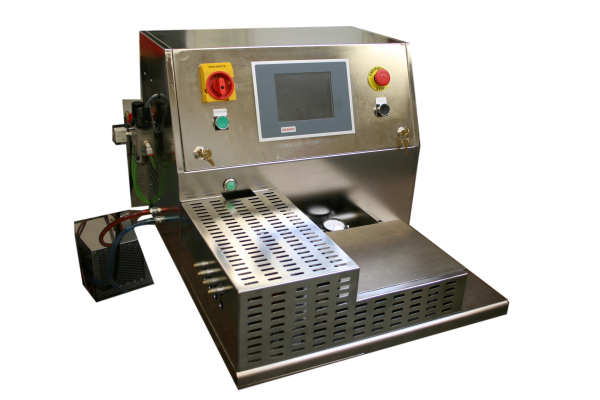
For validated production, automated tube feed cutting integrated with tip forming automation is the standard for any medium-to-high volume catheter program. The ONEX RF Tip Forming platform handles catheter sizes from 2.5Fr to 36Fr and operates on a compact footprint with no water cooling required. For manufacturers scaling to full production volumes, the ATF-Galaxy modular automation platform provides a configurable, expandable architecture that grows with production requirements.
The question of trimming efficiency is ultimately inseparable from the question of overall tip quality. A fast, automated cut that feeds into a poorly controlled forming process gains nothing. ONEX RF's design philosophy — vertically integrating die manufacturing, system engineering, process development, and validation support under one roof — reflects the understanding that trimming efficiency and tip quality are not separate problems. They are the same problem, solved together.






-2.gif)


.png)
-1.png)
-1.png)